
Are you living in Germany? As an expat, for an extended time? With a license from your home country? Do you feel the urge to speed along the autobahn once in a while? After six short months, you'll need a German driving license. Not a problem, right? Well, this is Germany. Read on for the gory details.
If you have a driving license from another country, of course you can. As a tourist. Or, as a resident, for the first six months of your stay. Presumably starting with your Anmeldebescheinigung. Or if your license is from the EU, it is valid until it expires.
Really, everone can zip along on the autobahn? Don't count on it. If your driving license is issued in the German language (Austria, Switzerland, Liechtenstein), no worries. Otherwise if you have an international driving license, that's good too. You are also in good shape if your license is from the states of Andorra, Hongkong, Monaco, New Zealand, San Marino, or Senegal. Or if it conforms to the “Muster des Anhangs 6 des Übereinkommens über den Straßenverkehr vom 8. November 1968”. Otherwise, it depends on the local Führerscheinbehörde.
Seriously, for those six months, get an international driving license. In the US, you can get it for about twenty bucks from any AAA office.
As a non-EU expat, once those magical six months of zipping along on the autobahn are over, it is time to embark on the Umschreibung. Actually, you should not wait six months, because, Germany. The process will drag on.
It depends. When the Federal Republic rose like a phoenix from the ashes of WW2, freshly-minted government officials contacted every country on the planet, as well as states and provinces that issue their own licenses, to suggest a reciprocity agreement. Thirteen US states must have tossed the letter, because they now have no reciprocity. That's bad news. You need to take both the theory and driving exams. Ten states and the District of Columbia have partial reciprocity (only the theory exam), and 27 US states and Puerto Rico, as well as all Canadian provinces have full reciprocity (hooray, no exam). You can find the full list of reciprocal countries here.
If you need a driving exam, you will be asked for your driving school when you start the process. You must take the exam in the city in which you reside. Find a driving school in that city, in order to practice on the roads that you will encounter during the exam. It might take some time to find a school that has an English-speaking instructor, and, if you don't drive stick shift, a car with an automatic transmission. Be prepared to pay an initiation fee (Grundgebühr) of several hundred Euro.
Your next step is the Bürgeramt. In Düsseldorf, make an appointment for Fahrerlaubnisbehörde → Umschreibung ausländische Fahrerlaubnis. Then you pick EU, Anlage 11 FeV (partial or full reciprocity), or sonstige Staaten (no reciprocity). Be persistent and keep trying at 7am and 9am every day when a trickle of appointments may become available.
You need the following:
If you are the lucky owner of a license from a full reciprocity country, state, or province, you are all set. Your German license will be ready for pickup in a few weeks or months, depending on when you can snag an appointment. (Pro tip: If you can't snag an appointment online, and you live in a tony suburb with a service-oriented Bürgeramt, such as Kaiserswerth, try going there. They may be able to get you one.)
Otherwise, you'll get paperwork entitling you take a theory test, or both the theory and driving test.
It is difficult for Americans to comprehend the complexity of the German theoretical driving exam. Or for Germans to grasp the more laid-back testing regime elsewhere in the world.
Everyone: Isnt' that crazy?
That German sample test is in German, but you can take it in any EU language. Which includes English, even after Brexit. Thank you Ireland for sticking around!!!
The worst part of the German test are the movies. You are driving along a country road. A fox crosses right before you. Kids kick a soccer ball in a field. A Rubik's cube tumbles across the road. And now: the question. How many moves does it take to solve the cube?
Just kidding about the Rubik's cube, of course. But in the catalog of about 1200 questions, so many are absolutely inane. Take this one:
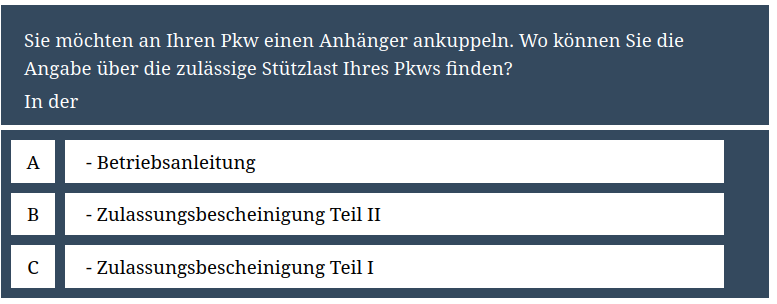
You would like to hitch a trailer to your car. Where do you find the maximum towing capacity?
Who cares??? When faced with that situation, what is the downside of looking in all three places?
In case, you still wondered. The correct answers are: 1 and 2. Yes, there can be more than one correct answer. Does that mean the information will be present in both the instruction manual and registration certificate part I? Or in one but not the other, depending on yet more mysterious rules and regulations? The mind reels.
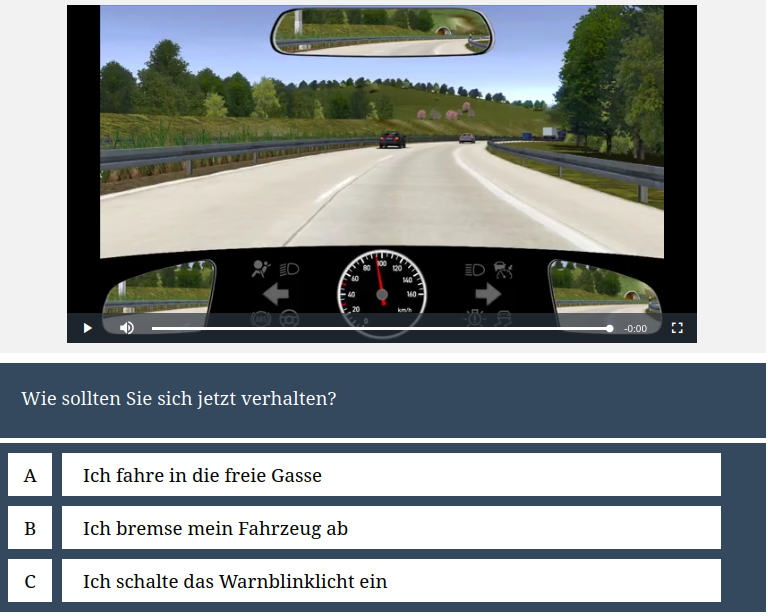
Or take this one. A car takes you over to the left. A slow truck is on the horizon to the right. Will you
Choice 1 is not advisable because you should not take over a slower car to your left. Braking might therefore be a good idea. But the warning light seems pretty far-fetched. Except you are supposed to divine that there is an accident ahead.
I could bore you with analyzing hundreds of other questions just like that. But it doesn't matter. You have to pass the test. And that means you just have to memorize the answers. It is a finite question catalog after all.
Get an app and practice until you've passed all the questions a few times. A few weeks of daily drudgery, and you'll be good to go. When I took the test, I watched my hand with amazement as it moved the mouse to the right answer, before my sentient brain had even comprehended the question. Whoa, zero mistakes, the examiner said. I don't see that every day.
Side note from an educator: That kind of mastery is a well-documented phenomenon when practice has immediate feedback. Complete novices who learn to keep an airplane level with a flight simulator are, with a couple of days of practice, just as good as professional pilots, as long as they get that immediate feedback during training. Our brains are really good at feedback. (As is your chatbot of choice.)
When I got my driving license in Ann Arbor, Michigan, many years ago, I had to get on and off a freeway, yield to pedestrians, stop at a traffic light and a four-way stop, and park (but not parallel). It felt stressful at the time, but as long as you were not a menace to society, you would pass.
That is not how a German driving exam works. The failure rate is about 50%. Maybe the German driving schools are really bad? Maybe the German driving students are numbskulls? Or maybe the exams are a bit over the top?
Given how many expat drivers fail who have driven without accident for years or decades in other places, it may be the latter.
Unfortunately, it is best to be prepared for trickery. In an exam, you might find yourself being directed into a confusing situation that seems specifically designed to fail you on a technicality.
Ask your driving instructor to show you some of the tricky routes where prior students messed up. It may take some prodding. Some driving instructors live in denial about how the game is rigged.
Make sure your Google location tracking is on as you take those driving lessons. Your driving instructor will make you practice along the routes that are commonly taken during an exam. Unfortunately, in Germany, you aren't allowed as a student to drive in the presence of a licensed driver. The next best thing is to take a driver along the recorded routes, and be on the lookout for confusing situations.
You will need to demonstrate that you can go really fast on the autobahn. In an urban area, there will only be a couple of places where that demonstration is possible. Be sure to have your designated driver traverse those, observing where the coveted “no speed limit” signs are.
Then, when you take the exam, you will note with bemusement as you are taken from one trap to another, and of course onto the racetrack at the autobahn. Show some kindness to pedestrians or cyclists, if the opportunity arises. But don't be excessive about it—after all, Germany. You may be among the lucky ones who pass at first try.
If not, it is a true pain to have to redo the test, because it can take many months to get another schedule spot. I think that no matter how unlucky, you will pass after a couple of tries when the examiner realizes how ridiculous the situation is.
German folklore states that you will then be handed your Führerschein on the spot, lovingly prepared by the Bundesdruckerei. That does not seem to be happening when you request an Überschreibung. After all, you might have taken the test just for the heck of it. So, you need to go back to the Verkehrsamt, with proof of passing the exam, to request a Fahrerlaubnis. And then another appointment to pick up your license.
The good news—the license is good for 15 years. Be sure to get it extended well before the deadline. Because, Germany.
With a Mastodon account (or any account on the fediverse), please visit this link to add a comment.
Thanks to Carl Schwann for the code for loading the comments.
Not on the fediverse yet? Comment below with Talkyard.
