Parsing 1
- Case classes
- Trees
- The Option type
- Expression trees
- Time to move to Eclipse
Case Classes
- Special kind of class, optimized for matching
case class ClassName(field1 : Type1, field2 : Type2, ...) extends Superclass
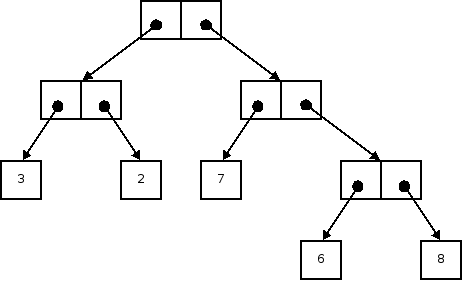
- Example: Binary tree with values only in the leaves
class SimpleTree
case class Leaf(value : Int) extends SimpleTree
case class Node(left : SimpleTree, right : SimpleTree) extends SimpleTree
- Construct instances with
ClassName(arg1, arg2, ...)
Node(Node(Leaf(3), Leaf(2)), Node(Leaf(7), Node(Leaf(6), Leaf(8))))
Pattern Matching
selectorExpr match {
   case pattern => expr
   ...
   case pattern => expr
}
- Many possibilities for the patterns; we care about case classes
tree match {
  case Node(l, r) => expr1
  case Leaf(v) => expr2
}
- Variables
l, r, v are bound to the
values in the case class instances; you can use them in the expressions.
def sum(t : SimpleTree) : Int = t match {
  case Node(l, r) => sum(l) + sum(r)
  case Leaf(v) => v
}
- Matches are tried in order. To have a default, use the
“wildcard” pattern at the end
case _
The Option Type
Syntax Trees
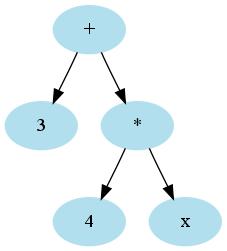
- Tree that represents the syntax of a program (or a program part)
- Example: Expression tree for
3 + 4 * x
- Model in Scala:
class ExprTree
case class Number(value : Int) extends ExprTree
case class Variable(name : String) extends ExprTree
case class Operator(left : ExprTree, right : ExprTree,
  f: (Int, Int) => Int) extends ExprTree
Operator(Number(3), Operator(Number(4), Variable("x"), _ * _), _ + _)
- Next lecture: How to parse
3 + 4 * x into Scala
value
Syntax Tree Evaluation
- Compute value of expression
- Need values of free variables
- Use a
Map[String, Int]
- Scala immutable maps:
Map(key1 -> value1, key2 -> value2, ...) yields
map with given key/value pairsmap + (key -> value) yields map with new key/value
pairmap(key) yields value of key (must exist)map.get(key) yields Option, either
Some(value)or None
def eval(expr : ExprTree, symbols : Map[String, Int]) : Int =
  expr match {
    case Number(num) => num
    case Variable(name) => symbols(name)
    case Operator(left, right, f) => f(eval(left, symbols), eval(right, symbols))
  }
IDE Survey
- What is your favorite professional Java IDE?
- Eclipse
- NetBeans
- IntelliJ
- I have no experience with professional IDEs
- I prefer another IDE (Give name in text field below)
Scala IDE Plugin
- As our programs get longer, the interpreter won't cut it any more
- Course goal from green sheet; Produce programs
in a functional programming language in excess of 200 LOC
- Use Eclipse IDE plugin
- If you don't have Eclipse installed, get it here.
- Install the Scala plugin, as described here
- Prefer Netbeans? Install 6.5 beta and get a plugin here. (It is actually a bit nicer
than the Eclipse plugin.)
Scala in Eclipse
Lab

- Check into eCampus in the usual way
- Scribe puts in report
- Buddy puts in comment with scribe's name
Step 1
Add the classes ExprTree, Number,
Variable, Operator to the Main.scala file. Add
the eval method to the Main object. In the
main method, construct the tree
and evaluate it with a symbol table in which x is 5. What is
the code of your Main.scala file?
If you didn't install Eclipse and the Scala plugin before class, then write
the file with a text editor (in a lab9 subdirectory to match the
package name) and compile/run with
scalac lab9/Main.scala
scala lab9.Main
Step 2
Now we want to add variable definitions (which we will write as val x
= expr in the next lecture). For now, we will assume that they are
already parsed into instances of
case class Definition(name : String, expr : ExprTree)
For example, a definition val x = 2 would be a
Definition("x", Number(2)). A definition changes the symbol table.
In a functional setting, that means we need to return a new table that contains
all bindings in the old table and the new binding. For example,
val def1 = Definition("x", Number(2))
val def2 = Definition("y", Variable("x"))
val sym0 = Map[String, Int]()
val sym1 = eval(def1, sym0) // "x" -> 2
val sym2 = eval(def2, sym1) // "x" -> 2, "y" -> 2
Implement this evaldefi.name,
defi.expr.)