The implementation in the elaboration phase should support architectural validation and and risk management.
- A use case should be written at a particular level of of detail. Cockburn recommends three levels: summary, user goal, and subfunction.
- The most common precedence dependency between schedule tasks is the finish-to-start dependency.
- It is reprehensible to add buffers, tasks whose sole purpose is to pad the schedule for unexpected delays.
- An application controller is responsible for locating a domain model method and for deciding what to view afterwards.
- Consider the task of showing a combo box with all users. In a transaction script architecture, this is simple: make a SQL query SELECT * FROM Users and populate the combo box with the result.
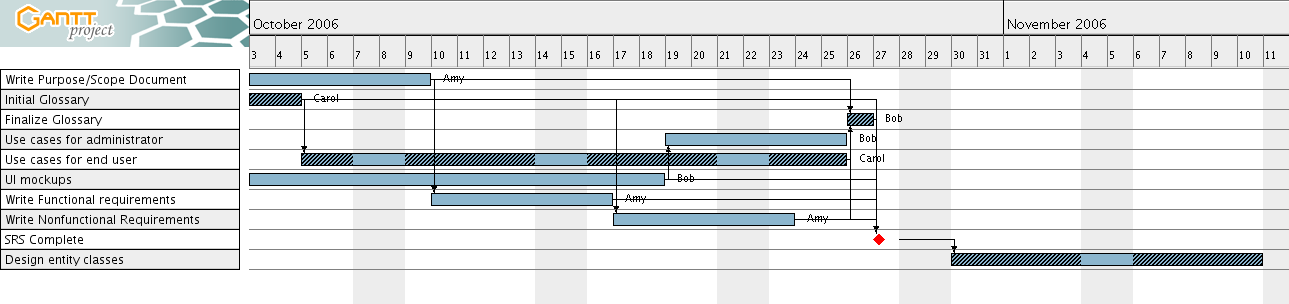
- Right now, Bob is overloaded. Resolve that problem by changing a
resource assignment, without overloading anyone else.
The easiest way to do this is to assign Carol to "Initial Glossary".
- Add a milestone for "SRS Complete" that depends on all SRS tasks and make the task "Design entity beans" a successor of that milestone.
- Replace "Write Use Cases" with two tasks "Write Use Cases for
End User" (15 days) and "Write Use Cases for Administrator (5 days).
The tasks can work in parallel. Make suitable resource assignments
for these two tasks that don't create overloads and minimize the
schedule.
Here is one solution. I had to add a non-functional dependency to avoid overloading Bob.
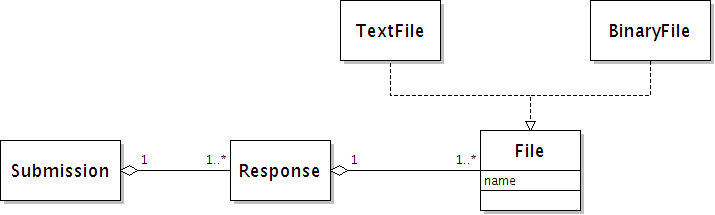
Produce a UML class diagram that denotes the following facts:
- A submission contains multiple responses. Each response contains multiple files. Each file has a name attribute. We distinguish between text and binary files.
However, copying to the autodeploy directory can be a bit flaky. A better way is to inform the application server that a file is ready for deployment. Sun's asant version of Ant provides a special task for this purpose. You should rewrite the deploy target to use this task. Read through the documentation, select the appropriate task, and figure out how to tell the task about your WAR file.
If you have the time, feel free to try it out: Place an HTML file in a doc subdirectory, start GlassFish, run asant -Dteam=foo, and point your browser to http://localhost:8080/foo-doc/myfile.html
<target name="deploy" depends="package">
      <sun-appserv-deploy file="${doc.war}"/>
</target>
- Misuse of the use case template
- Misuse of defined terms (as given in the homework1 description)
- Level of detail
- Completeness
- Logical correctness of the steps and their order
- No number. Each use case should be numbered for easy reference.
- No description of unhappy scenario "student gets imperfect grade". How can a student tell what went wrong? The homework has this to say: "Students will be able to see a report that shows how their assignment was graded: what worked, what error messages were caused, what actions were taken to make their programs compile, what remarks the instructor made..." The use case must address these issues.
- exam1.txt. The answers to problems 1, 2, 6.
- exam1.gan. The answer to problem 3.
- exam1.png. The answer to problem 4.
- build.xml. The answer to problem 5.
You will check your solution into your individual CVS sandbox, into a project entitled exam1. I will check out your work with the following commands:
export CVS_RSH=/usr/bin/ssh
export CVSROOT=:ext:username@oslo.cs.sjsu.edu:/home/cvsroot/sandbox/username
cvs checkout exam1